
The Railroads of Will County
Shortlines and Industrial Railroads
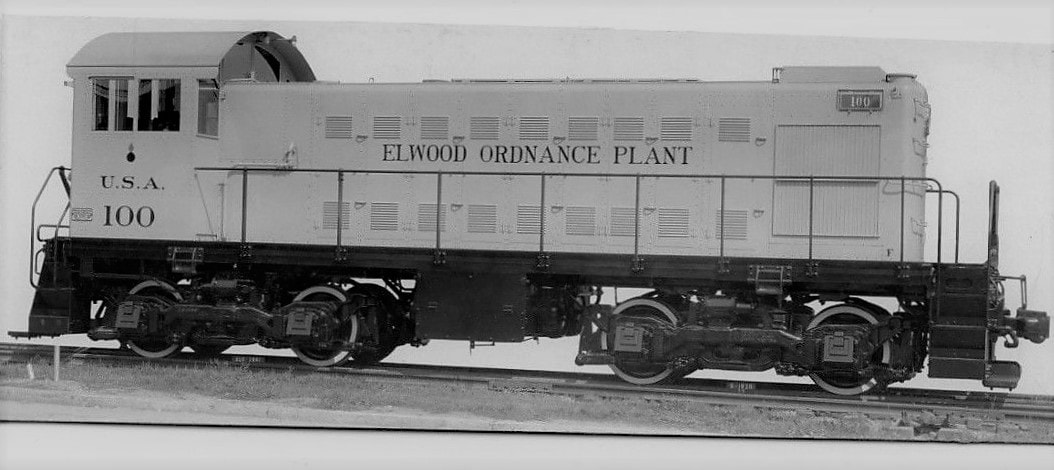
Joliet Army Ammunition PlantThe Joliet Army Ammunition Plant (JOAAP) was originally known as the Elwood Ordnance Plant (EOP) and the Kankakee Ordnance Works (KOW) when they were authorized by the federal government in 1940. The federal government purchased 36,645 acres from local farmers at a cost of $8,175,815. Construction costs totaled over $81 million. Seventy-seven such plants were built during World War II to produce ammunition and explosives for the U.S. military.
|
|
At the time they were built, the Joliet plants were considered the largest, most sophisticated munitions plants in the world. Both the Elwood and Kankakee plants became a training base that supported the Allies' efforts. At peak production during WW II, over 10,425 people were employed at the two plants. The Elwood facility loaded over 926 million bombs, shells, mines, detonators, fuzes, and boosters, and the Kankakee facility set a national record producing over one billion pounds of TNT. The plant had its own massive in-plant railroad, and the Santa Fe, GM&O, Milwaukee Road, and Wabash all directly served the plant.
The Elwood and Kankakee Plants were combined and re-designated the Joliet Arsenal in 1945, when operations were placed on standby. The Arsenal was reactivated in 1952-1957 during the Korean War and again during the Vietnam War. TNT production stopped in 1976 and by the late 1970s, most operations had ceased. The total size of the Joliet Army Ammunition Plant at the time it was declared inactive in 1993 was 23,543 acres, which has been divided into the Joliet Army Training Area, the CenterPoint Intermodal Center (with giant intermodal faciities for BNSF and UP,) the Abraham Lincoln National Cemetery, and the Midewin National Tallgrass Prairie.
(Joliet Army Ammunition Plant history from the U.S. Forest Service)
The Elwood and Kankakee Plants were combined and re-designated the Joliet Arsenal in 1945, when operations were placed on standby. The Arsenal was reactivated in 1952-1957 during the Korean War and again during the Vietnam War. TNT production stopped in 1976 and by the late 1970s, most operations had ceased. The total size of the Joliet Army Ammunition Plant at the time it was declared inactive in 1993 was 23,543 acres, which has been divided into the Joliet Army Training Area, the CenterPoint Intermodal Center (with giant intermodal faciities for BNSF and UP,) the Abraham Lincoln National Cemetery, and the Midewin National Tallgrass Prairie.
(Joliet Army Ammunition Plant history from the U.S. Forest Service)
Joliet Junction Railroad
In 1991, the EJ&E discontinued service on its 6.46-mile Rockdale Line – between Rockdale Junction in Crest Hill and Rockdale, after a fire severely damaged a wooden trestle. In 1994, the newly founded Joliet Junction Railroad acquired the Rockdale Branch from the EJ&E, which had sought to abandon the line after the fire. It would cost $90,000 to replace the bridge, plus significantly more for other expenses to bring the line up to code.
The Joliet Junction Railroad applied for and received a $390,000 loan from the Illinois Department of Transportation to fund improvements. The Joliet Junction connected local shippers with the national railroad network at two connection points: with the EJ&E at Crest Hill and with CSX Transportation at Rockdale. The Joliet Junction Railroad ceased operations in the summer of 1999, and sold the trackage for $467,424 to the Forest Preserve District of Will County, which created a recreational trail, called the Joliet Junction Trail, over the former right-of-way.
The Joliet Junction Railroad applied for and received a $390,000 loan from the Illinois Department of Transportation to fund improvements. The Joliet Junction connected local shippers with the national railroad network at two connection points: with the EJ&E at Crest Hill and with CSX Transportation at Rockdale. The Joliet Junction Railroad ceased operations in the summer of 1999, and sold the trackage for $467,424 to the Forest Preserve District of Will County, which created a recreational trail, called the Joliet Junction Trail, over the former right-of-way.